
Cancún is the way into Playa del Carmen and the Riviera Maya, in Quintana Roo, Mexico, and for most of North America it is a short flight: 1 hr 53 min from Miami, 2 hr 45 min from Dallas, about 4 hr 20 min from New York or Toronto. The airfare is still the single biggest line in the budget, and it moves: the same seat on the same aircraft runs about $340 in a shoulder month and past $630 over Christmas. We pulled the published 2026 schedules, twelve months of comparator fare data and the airlines' own fare rules to say what to buy, when, and what to refuse.
Which airlines fly nonstop to Cancún from the US and Canada
More than a dozen airlines fly nonstop to Cancún (CUN), and from most large North American hubs the trip is shorter than a domestic coast to coast. The airport sits 34 miles (55 km) north of Playa del Carmen, and there is no closer commercial option worth the detour except Tulum, which we come back to further down.
From the United States, all four legacy carriers serve it: American, Delta, United and Alaska. American is the single biggest operator on the route network, with 42 weekly departures from Dallas/Fort Worth alone. The low cost side is just as dense: Southwest, JetBlue, Frontier, Spirit, Sun Country and Allegiant. Aeroméxico, Volaris and VivaAerobus also sell cross border seats, usually with a Mexican connection.
From Canada, five airlines fly nonstop: Air Canada, WestJet, Air Transat, Porter and Flair. Toronto alone has 32 nonstop flights a week, which is more than New York and Chicago combined.
| From | Nonstop time | Nonstop airlines | Flights a week | 12 month average round trip |
|---|---|---|---|---|
| Miami (MIA) | 1 hr 53 min | American, Aeroméxico, LATAM | 18 | About $402 |
| Houston Hobby (HOU) | 2 hr 12 min | Southwest | 21 | About $478 |
| Atlanta (ATL) | 2 hr 38 min | Delta, Frontier, Southwest | 34 | About $443 |
| Dallas/Fort Worth (DFW) | 2 hr 45 min | American, Frontier | 26 | About $435 |
| Chicago O'Hare (ORD) | 3 hr 49 min | American, United, Frontier | 14 | About $473 |
| New York (JFK) | 4 hr 20 min | JetBlue, Delta, American | 13 | About $498 |
| Toronto (YYZ) | 4 hr 20 min | Air Canada, WestJet, Air Transat, Porter, Flair | 32 | About $396 |
| Montréal (YUL) | 4 hr 30 min | Air Canada, Air Transat, WestJet, Flair | 14 | About $497 |
Our take: on a flight this short, the cabin barely matters and the fare rules matter enormously. A JetBlue or Delta main cabin seat and a Frontier seat are two hours apart in comfort and often $120 apart once you add a bag. Read the baggage line before you compare prices, because that is where the gap closes back up, and we break down exactly how below.
How long is the flight to Cancún, and what time is it when you land
Nonstop times run from 1 hr 53 min out of Miami to about 4 hr 30 min out of Montréal, and they are close to identical in both directions. Unlike a transatlantic route, there is no strong headwind penalty here: the outbound and the return differ by 10 to 20 minutes, not by an hour.
With one connection, plan on 6 to 9 hours gate to gate from an East Coast or Texas hub, and 8 to 11 hours from the West Coast. A second connection pushes you past 12 hours, which on a route this short is never worth the saving.
The time zone is the part people get wrong. Quintana Roo sits on UTC-5 all year and never changes its clocks, because Mexico abolished daylight saving in 2022. So the difference depends on the season, not on the state:
- November to March: Cancún is on the same clock as New York, Miami, Toronto and Montréal, and one hour ahead of Chicago and Dallas.
- March to November: Cancún is one hour behind New York, Miami, Toronto and Montréal, and on the same clock as Chicago and Dallas.
That is a one hour shift at most, so there is no jet lag to plan around, and an early morning flight south usually means a full first day on the beach. We go into the fuzzier cases, including the ones that catch people out on tour pickup times, in our guide to the Playa del Carmen time zone.
What a round trip to Cancún costs, month by month
The US average round trip to Cancún sat near $514 over the past twelve months, and anything under $388 falls in the cheapest quarter of fares searched. Those two numbers are the ones to hold onto, because they tell you when to stop shopping.
Below, the seasonal curve. Be clear about what is measured and what is read off the curve: the twelve month averages per hub are measured (New York $498, Miami $402, Dallas $435, Chicago $473, Atlanta $443, Toronto $396, Montréal $497), as are each hub's cheapest and dearest month. The monthly bands are our reading of that curve across major hubs, not a quote on your dates.
| Period | Typical round trip from a major hub | What is going on |
|---|---|---|
| Early January, after the 6th | $310 to $400 | The post holiday floor. Cheapest month out of Chicago ($366) and Toronto ($310) |
| February | $335 to $430 | Cheapest month out of Dallas ($337) and Atlanta ($343), Presidents' week excepted |
| March | $450 to $560 | Spring break. The dearest month out of Chicago ($553). Great weather, packed town |
| April, after Easter | $345 to $450 | Cheapest month out of Miami ($345). The most underrated window of the year |
| May to mid June | $360 to $460 | Second trough. Hot, cheap, quiet |
| Late June to early August | $450 to $590 | Summer break. Dearest month out of New York ($583) and Toronto ($489) |
| September | $420 to $520 | Cheapest month out of New York ($420) and Montréal ($426). Also peak hurricane season |
| October and early November | $400 to $500 | Cheapest month out of Houston ($407), and the weather improves sharply after the 20th |
| Thanksgiving week | $500 to $650 | A short, sharp spike in an otherwise excellent month |
| December 18 to January 5 | $480 to $760 | The annual peak. Dearest month out of Dallas ($482) and Montréal ($633) |
Two conclusions worth acting on. First, the best value weeks of the year are the second half of January, the ten days after Easter and late April into May: fares near their floor with dry season sky still in place. Second, if your dates are set by a school calendar, stop hunting for a deal. Spring break, the Fourth of July and Christmas are captive demand. Your only lever is buying early.
The catch on the cheapest months is real: September and early October are the wettest weeks of the year and the peak of hurricane season. Cross the fare against the weather in our guide on the best time to visit Playa del Carmen, and against the seaweed calendar in our guide to sargassum in Playa del Carmen before you lock dates in April through August.
When to book your flight to Cancún
Book 6 to 10 weeks out. That is where comparator data puts the floor on almost every US and Canadian hub, and the saving against a last minute purchase runs from 13 to 39 percent depending on the route. Kayak's twelve month reads: 6 weeks out of Houston (39 percent cheaper), 6 weeks out of Miami (28 percent), 10 weeks out of Dallas (19 percent), 9 weeks out of New York (13 percent), 6 weeks out of Toronto (20 percent). Google's own spring break analysis lands in the same place, with the best fares clustering 28 to 61 days out.
The calendar that works:
- More than 6 months out: airlines open the route in expensive booking classes. You are buying certainty, rarely a good price. The one genuine exception is December 20 to January 5, where buying in June or July is the only way to stay under $500.
- 4 to 3 months out: fares start easing. This is the moment to set a price alert, not to buy.
- 10 to 6 weeks out: the window. Airlines re-price booking classes against real load factors, and that is when fares break.
- Inside 3 weeks: prices climb again, mechanically. On a route with 30 flights a week there is still inventory, but it is sold at walk up prices.
Two habits that pay better than the comparator itself. Shift your dates by 48 hours: Tuesday averages $513 round trip against $562 on Thursday across the US to Cancún market, and on some hubs the Monday or Sunday gap is larger still. And price the second airport at both ends: Houston Hobby against Intercontinental, Newark against JFK, and Tulum against Cancún, which we cover below.
Cancún airport's four terminals: which one is yours
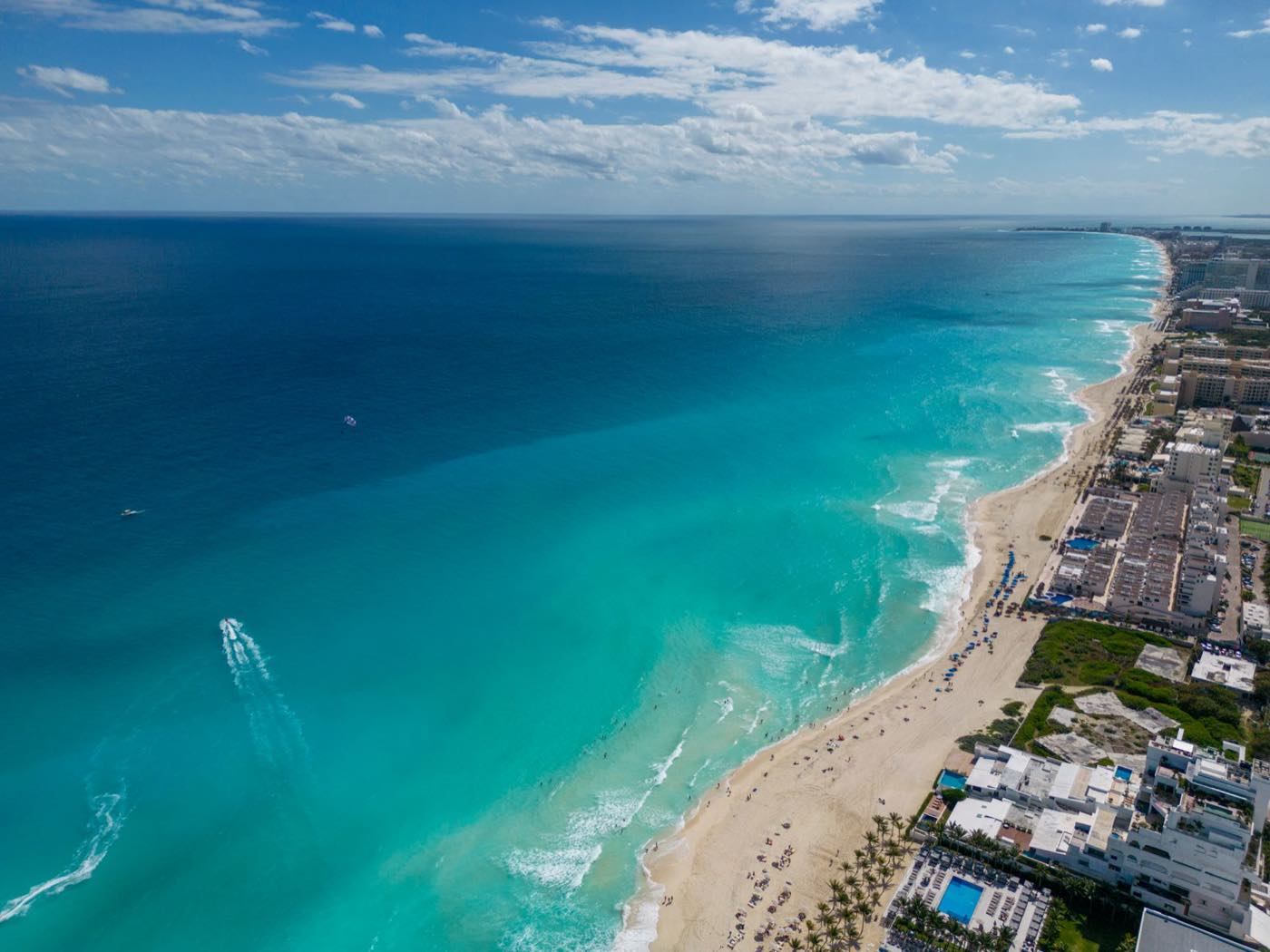
Cancún International has four terminals, and which one you land in depends entirely on your airline. It changes where you walk out, where a driver can meet you and which bus stop you are looking for.
| Terminal | Profile | Airlines that matter to a US or Canadian traveler |
|---|---|---|
| Terminal 1 | Charter and private aviation, under full reconstruction, reopening announced for 2026 | No scheduled US or Canadian service |
| Terminal 2 | Domestic plus some international, 22 gates | Volaris, VivaAerobus, Alaska, Magnicharters |
| Terminal 3 | International, 21 gates | American, Delta, United, Spirit, Air Canada |
| Terminal 4 | International and domestic, 14 gates, opened 2017 | JetBlue, Southwest, Frontier, WestJet, Air Transat, Sun Country, Aeroméxico |
So the short version: the three legacy US carriers and Air Canada put you in Terminal 3; JetBlue, Southwest, Frontier and WestJet put you in Terminal 4. Both are modern and well signed, but they are not adjacent buildings. If you are giving a meeting point to a driver or to friends, give the terminal number, never just "Cancún airport". Check it again the day before you fly home, because assignments shift from one season to the next.
Immigration itself has gone digital. The paper FMM tourist card is gone for air arrivals, replaced by an electronic record and e-gates with facial recognition, so there is no form to fill out on the plane. Your permitted stay is recorded digitally and you can check it later on the INM portal rather than on a slip of paper you must not lose. What that means practically: keep your passport handy, keep the entry stamp or e-gate receipt if you get one, and do not throw away anything immigration hands you.
Once you are outside, Playa del Carmen is 34 miles (55 km) south and about an hour away. We compare the ADO bus, shared shuttle, private transfer and rental car in our guide to getting from Cancún airport to Playa del Carmen.
Flying from Canada, and the Tulum airport question
From Canada, Cancún is close to a domestic flight, and Toronto is the cheapest major gateway in North America on this route. Toronto averages about $396 round trip over twelve months, with January the floor at $310 and August the ceiling at $489, on 32 weekly nonstops split between Air Canada, WestJet, Air Transat, Porter and Flair. Montréal is thinner and dearer: 14 flights a week, about $497 average, and a December that runs to $633. Watch two dates in particular, March break and the Christmas fortnight, where Canadian fares double without difficulty.
The other question worth asking is whether you should fly into Tulum at all. Tulum International (TQO) opened on December 1, 2023, handled 1.25 million passengers in 2025, and now has nonstop US service from Atlanta on Delta, Dallas/Fort Worth and Miami on American, Houston on United, New York JFK on JetBlue, plus Newark seasonally from December 2026. Canada has Toronto and Montréal on Air Canada, WestJet and Air Transat, with Calgary seasonally.
Our position is narrow and specific. For Playa del Carmen, Cancún still wins. TQO is 12 miles (20 km) southwest of Tulum town and about 65 road miles (105 km) from Playa del Carmen, against 34 miles (55 km) from Cancún: you trade a one hour transfer for a transfer of roughly an hour and forty. Add thinner schedules, so a cancellation has fewer recovery options, and a transfer market that is still less competitive. Fly into TQO only if you are staying in Tulum itself or south of it, or if the fare gap is over $150 per person and the timing suits you. For a Playa del Carmen trip, Cancún is the default.
The traps that inflate the bill
The first trap is the checked bag, and on this route it is now the norm rather than the exception. American charges $45 for the first checked bag when you pay online, $50 at the airport, plus $5 more on a Basic Economy ticket, and that is each way. Southwest, the last US holdout, ended free bags in May 2025 and raised the fee again in April 2026: $45 for the first bag and $55 for the second on tickets booked from April 9, 2026. Frontier and Spirit sell a personal item only on their base fare, with the carry on itself priced as an extra. A nonstop that shows $60 cheaper than the one next to it is the more expensive of the two the moment you add one suitcase each way for two people.
The second trap is a short connection in Mexico City. A flight to Mexico City and then on to Cancún is not an ordinary connection, because Mexico City is your point of entry into Mexico. You collect your bags, clear immigration and then customs, and re-check your suitcases before the domestic leg, with a possible move between Terminals 1 and 2 on the aerotrén. Never book under 3 hours of connecting time in Mexico City. The 1 hr 30 min itineraries some search engines offer are an invitation to spend the night there.
The third trap is the arrivals hall itself. Between customs and the exit doors at Terminals 3 and 4 runs a corridor of booths that look like information or transport desks and are not. They sell vacation club and timeshare presentations, usually dressed up as a free transfer, a free tour or a resort credit in exchange for 90 minutes of your first morning. The rule is simple and it never fails: no legitimate transport is sold inside that corridor. Your prepaid transfer, the authorized taxi rank and the ADO bus counter are all outside, past the sliding doors. Say no, keep walking, do not stop to "just check the address".
The fourth point is about taxes, and it is the reassuring one. The Mexican airport use fee, the TUA, runs 861 pesos (about $51) for an international departure from Cancún and 351 pesos (about $21) for a domestic one, and it is already inside your ticket price. Nothing to pay at the counter. The Visitax, the Quintana Roo state tourist fee, is never included: budget 283 to 285 pesos (about $17) per person, paid online at the official state portal, visitax.gob.mx, before you fly home. Mexican citizens and residents are exempt; foreign visitors are not, and enforcement tightened through 2025 and 2026 with dedicated kiosks scanning QR codes in the Cancún check in hall. Sources disagree on whether young children are exempt, so check the official portal rather than a blog, this one included.
Nonstop at a premium or a connection $150 cheaper: do the math
On a route this short, take the nonstop until the gap passes roughly $150 per person, and take it regardless of the gap on a trip of under 8 nights. Here is the reasoning, with numbers.
A 2 hr 45 min nonstop from Dallas against a 7 to 9 hour one stop itinerary is 5 hours of extra travel each way, so about 10 hours across the trip. A $150 saving means you are being paid about $15 an hour to sit in a connecting airport. For a solo traveler with a flexible schedule, fine. For a family of four, the connection saves $600 and the arithmetic flips hard.
Our position, stated plainly:
- A US domestic connection (Charlotte, Atlanta, Houston) saving $150, with 1 hr 30 min to 3 hours on the ground: take it if you are two adults and unhurried. Bags are checked through, there is no intermediate immigration, the risk is a missed connection and nothing worse.
- A connection in Mexico City saving $150: take the nonstop. Bag recheck, immigration, customs and a possible terminal change buy you stress and the real chance of a lost night.
- A gap under $75 per person: nonstop, without thinking about it, whatever the party size.
- A gap over $300 per person: the connection becomes the rational call even with kids, provided you leave at least 1 hr 30 min and are not connecting through a winter weather hub in January.
- A trip of fewer than 8 nights: nonstop. Losing two half days of a short holiday costs more than $150.
One last factor that gets ignored: the landing time. A nonstop that puts you on the ground at 2 pm gets you to Playa del Carmen in daylight and onto Quinta Avenida for dinner the same evening. A connection that lands at 11 pm means a night transfer booked in advance and a first day written off. Look at the arrival time before you look at the price, then build the rest of the week with our guide on things to do in Playa del Carmen.
Keep going


Frequently asked questions
Which airlines fly nonstop to Cancún from the United States?
American, Delta, United, Alaska, Southwest, JetBlue, Frontier, Spirit, Sun Country and Allegiant all operate nonstop service, alongside Aeroméxico, Volaris and VivaAerobus. American is the largest operator on the route network, with 42 weekly departures from Dallas/Fort Worth alone. From Canada, Air Canada, WestJet, Air Transat, Porter and Flair fly nonstop, with 32 flights a week out of Toronto.
How long is the flight to Cancún?
1 hr 53 min from Miami, 2 hr 12 min from Houston Hobby, 2 hr 38 min from Atlanta, 2 hr 45 min from Dallas/Fort Worth, 3 hr 49 min from Chicago O'Hare, about 4 hr 20 min from New York JFK and Toronto, and about 4 hr 30 min from Montréal. Times are close to identical in both directions. With one connection, plan on 6 to 9 hours gate to gate from an East Coast or Texas hub.
What is the cheapest month to fly to Cancún?
It depends on your hub, which is why a single answer misleads. January is the floor out of Chicago ($366) and Toronto ($310), February out of Dallas ($337) and Atlanta ($343), April out of Miami ($345), September out of New York ($420) and Montréal ($426), and October out of Houston ($407). The US average across twelve months is about $514, and the peak is always December 18 to January 5. Cross the fare against the weather in our guide to the best time to visit Playa del Carmen.
How far in advance should I book a flight to Cancún?
6 to 10 weeks out. That is where comparator data puts the floor on nearly every US and Canadian hub, with savings against a last minute purchase of 13 to 39 percent depending on the route. The one exception is December 20 to January 5, which you should buy in June or July if you want to stay under $500.
Should I fly into Tulum airport instead of Cancún for Playa del Carmen?
Usually no. Tulum International (TQO) is about 65 road miles (105 km) from Playa del Carmen against 34 miles (55 km) from Cancún, so you trade a one hour transfer for closer to an hour and forty, on thinner schedules with fewer recovery options if a flight cancels. Fly into TQO if you are staying in Tulum or south of it, or if the fare gap is over $150 per person. Otherwise Cancún is the default.