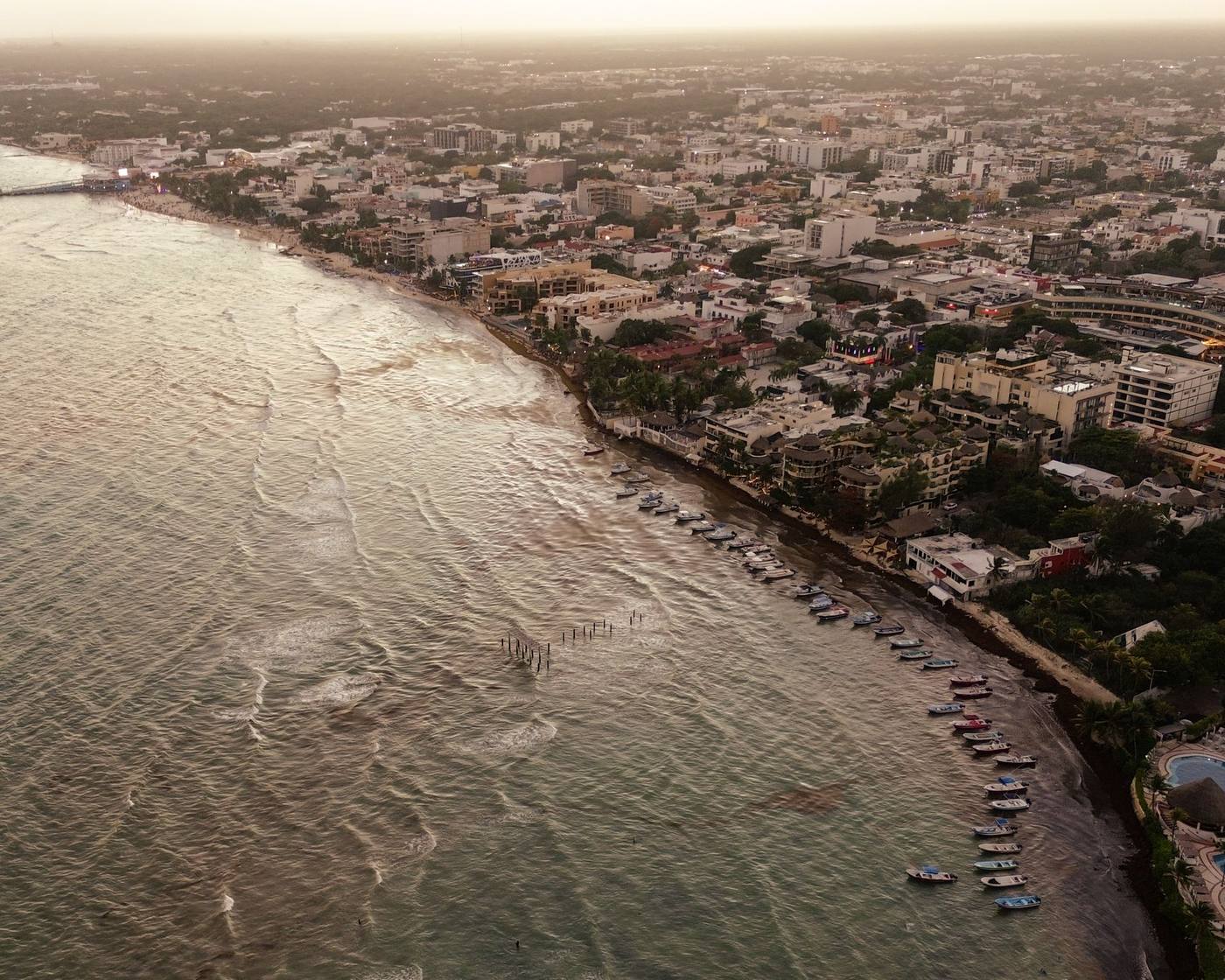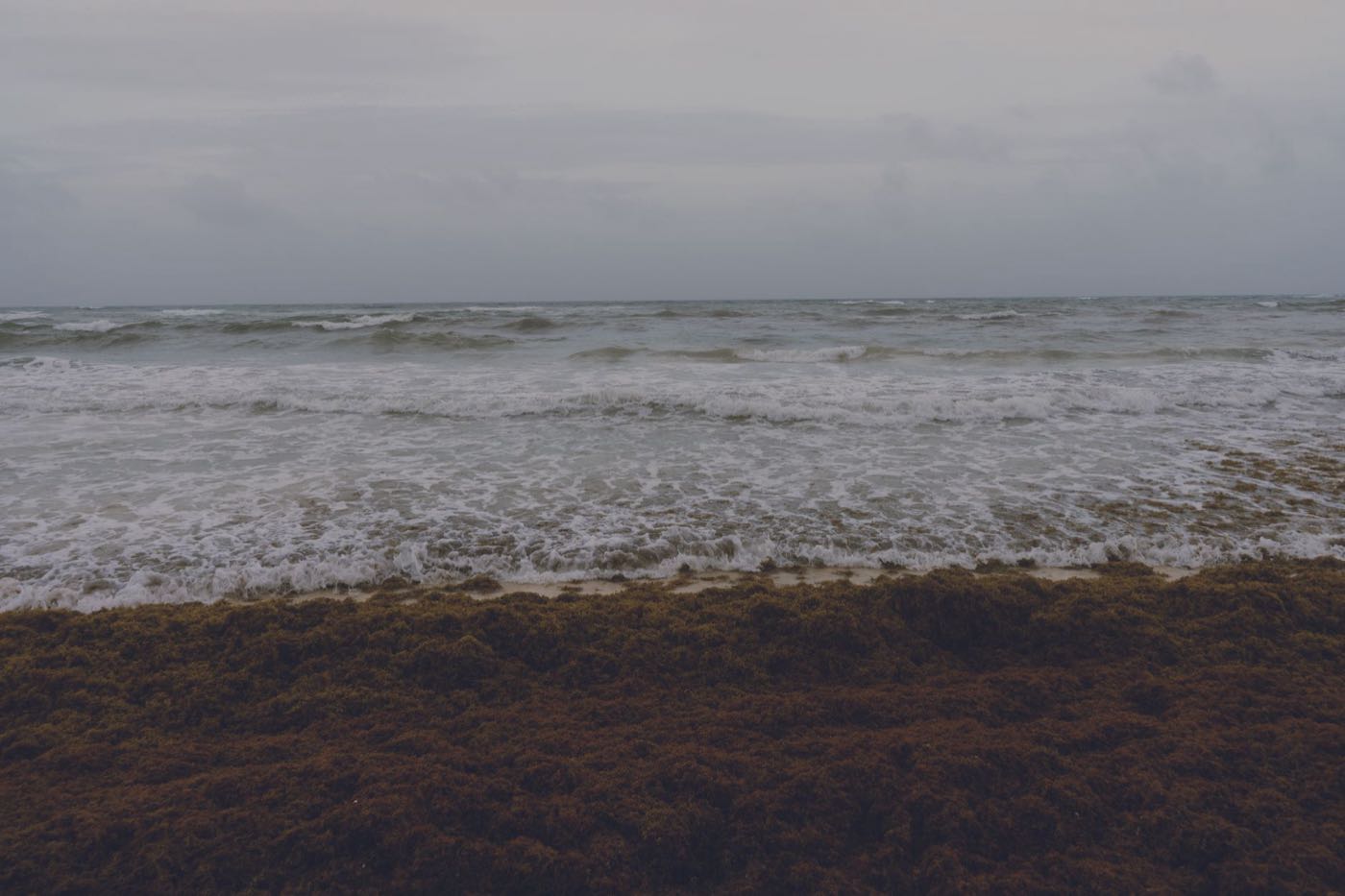

Yes, Tulum is the most sargassum-exposed beach on the Riviera Maya, in the state of Quintana Roo, Mexico. More than Playa del Carmen, far more than Cancún. That is not a reason to cut Tulum from your itinerary, but it is a reason to plan the trip differently. The bulletin just below gives you today's arrival index for Tulum plus the NOAA satellite map. The rest of this page explains why Tulum absorbs everything, when it happens, beach by beach, and where to go swimming when the sea turns brown.
Today's conditions, Tulum
Loading conditions…
NOAA satellite map of inundation risk
Produced daily by NOAA and the University of South Florida from satellite imagery. Red means high risk, orange medium, blue low.

Is there sargassum in Tulum right now?
Yes, Tulum is the most exposed stretch of coast on the Riviera Maya, and in season the honest answer is almost always "yes, at least some." Today's index sits in the bulletin at the top of this page: it cross-checks wind with time of year to estimate the arrival, and shows the NOAA satellite map, updated daily, which tracks the rafts drifting about 30 miles (50 km) off the Quintana Roo coast.
For beach-by-beach detail, the reference source stays the Red de Monitoreo del Sargazo de Quintana Roo. Every morning it posts a color-coded map of the whole coastline, Cancún to Mahahual, on Facebook: green (clean), yellow (light), orange (moderate), red (heavy). Tulum shows up orange or red most days between April and August. If you are already on the ground, that is the map to check over coffee, before you decide between beach and cenote.
For the mechanism itself, where the seaweed comes from and why it lands on this coast, read our guide to sargassum in Playa del Carmen. This page is about what makes Tulum different.
Why Tulum gets hit harder than Playa del Carmen or Cancún
Tulum carries three handicaps its neighbors do not: a coastline that faces due east, no island to shield it, and a hotel zone too small to defend itself.
1. Geography. Sargassum arrives from the east, pushed by the trade winds and the Caribbean current. Cancún is partly sheltered by Isla Mujeres and by the angle of its hotel zone. Playa del Carmen has Cozumel, an 11 mile (18 km) offshore screen that deflects part of the drift. Tulum has nothing in front of it. Its shoreline, from the archaeological site down to the Sian Ka'an reserve, looks straight out at the open Atlantic. Everything drifting toward this latitude lands on its 6 miles (10 km) of sand.
2. Hotel size. In Cancún and Playacar, resorts of 300 to 800 rooms pay for floating barriers 100 to 200 yards offshore, collection boats and front loaders working the sand from 6 am. Tulum's hotel zone is built from boutique properties of 10 to 40 rooms, many of them still off the power grid. None of them can fund a 1,600 foot barrier. Cleaning is done with rakes, by two or three staff, and it does not keep up on a heavy landing day.
3. The reef. The barrier reef that breaks the swell off Puerto Morelos or Akumal is more broken up in front of Tulum. The rafts come straight through and beach themselves.
The result: where Playa del Carmen alternates clean days and brown days, Tulum can stay brown for weeks at a stretch in May, June or July. In the big years (2015, 2018, 2019, 2022), mats 20 inches to 3 feet thick covered the full width of the beach along the southern strip.
Tulum sargassum season, month by month
The calendar matches the rest of the coast, with the intensity turned up at every stage.
| Period | Level in Tulum | What it actually changes |
|---|---|---|
| November to February | Low | The postcard beach genuinely exists. Best window, also the priciest |
| March | Low to moderate | First rafts, mostly south of the hotel zone. Spring break is usually fine |
| April to June | Very high | Peak. Brown beach most days, smell on windless afternoons. Plan cenotes |
| July to August | Very high | Still heavy, with 91 to 95°F (33 to 35°C) heat speeding up decomposition |
| September to October | Moderate | Clear decline, but erratic. Also rainy season and hurricane risk |
Two caveats that hold for Tulum as anywhere. Every year is different: 2023 was noticeably calmer than 2022. And even in June, two days of west or north wind are enough to clear the bay. Which is why you check the bulletin in the morning instead of giving up in advance.
If your dates are still open, our guide to the best time to visit Playa del Carmen lays out the trade between seaweed, rain, price and crowds. For Tulum the ideal window is narrow: mid-December to the end of March.
Tulum's beaches against the seaweed
Tulum has four beach sectors, and in season they are not remotely equivalent. South to north:
The southern hotel zone (Boca Paila)
This is the Instagram beach, and the worst affected. It runs about 4 miles (7 km) between the national park arch and the Sian Ka'an entrance. Most hotels sit directly on the sand with no offshore protection at all. On red days on the Red de Monitoreo map, it is brown end to end. The beach clubs (minimum spend of 500 to 1,500 pesos, about $27 to $81) clean their own frontage in the morning, not the 100 feet next door. Out of season, this is one of the finest beaches in Mexico. In season, it is a gamble.
The ruins beach (Playa Ruinas)
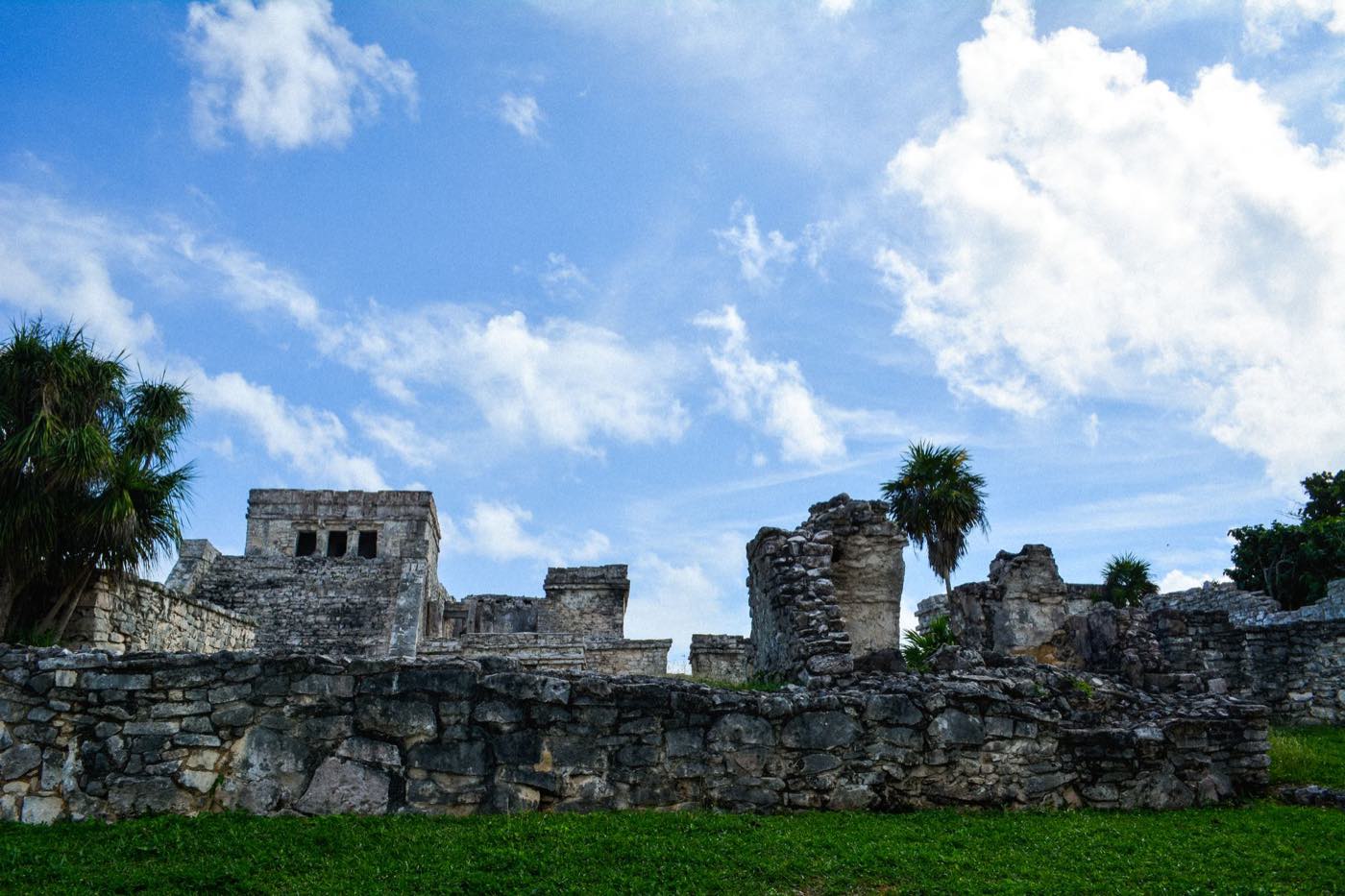
The small cove under the cliff of the archaeological site is often the first to fill up: it is enclosed, and it holds whatever drifts in. You reach it from inside the site (265 pesos, about $14, for foreign visitors, covering the three separate fees; open 8 am to 5 pm, last entry 3:30 pm) down a wooden staircase. From November to March it is a genuinely rare moment: swimming below the Temple of the Descending God. From April to August it is regularly closed to swimming, or simply unusable. Come for the ruins, not for the water.
Playa Paraíso
Just north of the site, this is Tulum's big public beach, the one with affordable beach clubs and colectivo access. It has one real advantage: the town and the clubs rake it by hand every morning, usually between 6 am and 9 am. On orange days it stays usable until roughly midday. On red days it does not. If you want to try the sea in season, this is the beach to aim for.
Playa Pescadores
A little further north, the fishermen's beach is where snorkeling boats leave for the reef (300 to 600 pesos, about $16 to $32, for 1 hour to 1 hr 30). Same hand cleaning in the morning as Paraíso, same logic. Its real asset is the boat: 300 yards out, the water turns turquoise again even when the shoreline is brown.
One rule applies everywhere: in season, you do the beach between 7 am and 10 am. In the afternoon the sea breeze brings the mats back.
Where to swim when Tulum beach is brown
This is where Tulum takes the lead back: no other town on this coast has this much clear fresh water within 20 minutes. Prices below are what visitors paid in 2026 and they move every year, so confirm at the gate.
- Gran Cenote: the famous one, 2.5 miles (4 km) from town on the Cobá road (10 minutes by car, 15 by bike). Clear water, turtles, a passage between two caverns. 500 pesos ($29), open 8 am to 4:45 pm. Expensive and busy, but the best one at that distance. Show up at opening.
- Cenote Calavera: 2 miles (3 km) out, same road. A hole in the rock you jump into from 10 feet up. 250 pesos ($15), plus 50 pesos for a life vest. Small, fills fast, perfect for an hour.
- Dos Ojos: 12 miles (20 km) north (20 minutes), the big cenote park. Two "eyes" linked by a 1,300 foot gallery, snorkeling or cavern diving. 350 pesos ($21) for snorkeling, from 1,600 pesos ($94) for a guided dive, open 8 am to 5 pm. The best one for snorkeling.
- Casa Cenote: 6 miles (10 km) north, an open cenote fringed with mangrove, 100 yards from the sea. About 200 pesos ($12). Ideal with kids or for a first dive.
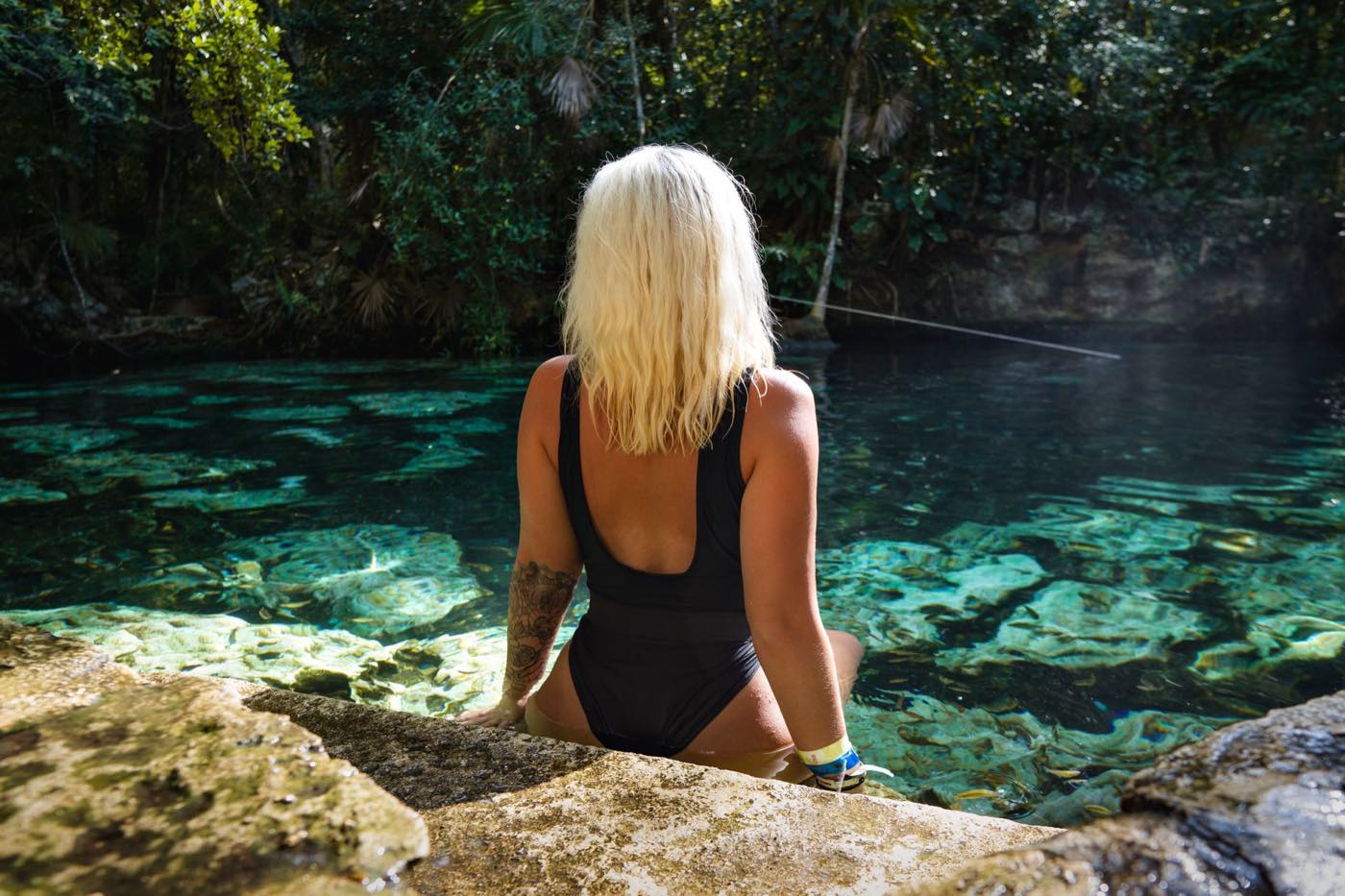
- Laguna Kaan Luum: 7.5 miles (12 km) south (15 minutes), a turquoise freshwater lagoon with a 260 foot sinkhole in the middle, divers only. 300 pesos ($18), open 9 am to 4 pm. Deck, hammocks, quiet on weekdays. The single best answer to a sargassum day.
- Akumal: 15 miles (25 km) north (30 minutes), the turtle bay. It faces northeast and sits behind its reef, so it is less affected than Tulum without being spared. Beach access is free; snorkeling inside the turtle zone requires a CONANP-licensed guide, 500 to 800 pesos ($29 to $47) for a session of about 55 minutes.
- Cobá: 28 miles (45 km) inland (45 minutes), jungle ruins plus three closed cenotes 4 miles (6 km) from the site (Choo-Ha, Tamcach-Ha, Multun-Ha), 100 to 150 pesos each. A full day without seeing the sea.
- Bacalar: 125 miles (200 km) south (about 2 hr 30 of driving), the lagoon of seven colors. Fresh water, never any sargassum. Two nights at the end of a trip can rescue a beach vacation.
To compare every cenote in the region, including the ones closer to Playa, see our cenotes guide.
How to choose a Tulum hotel in sargassum season
From April to August, one question decides it: what will you do if the beach is brown for your entire stay? If the hotel has no answer, pick another hotel.
- Search the reviews from the last 3 months for "barrera antisargazo." Very few Tulum hotels have one. The ones that do not talk about "daily cleaning," which means a rake.
- A real pool, not a 13 by 20 foot plunge basin. Plenty of Tulum beach hotels built a token pool because the sea was supposed to be enough.
- A private cenote. About a dozen jungle-side hotels have one on the property. In season, that is the actual luxury.
- Sleep in town or on the jungle side, not on the beach. A $110 to $180 room in town plus a beach club day pass costs less than a $450 room facing a mat of seaweed, and you get to choose every morning where to go.
- Book free cancellation. No hotel refunds anyone over sargassum.
If your trip is beach-first, the most rational play in season is to sleep in Playa del Carmen or Playacar and do Tulum as a day trip: 40 miles (65 km), about an hour by car, 50 to 80 pesos ($3 to $5) by colectivo. Playacar has barriers, Cozumel is a 40 minute ferry away, and Tulum's ruins and cenotes stay within reach. From the airport, the Cancún to Playa del Carmen run works fine without a rental car.
So should you still go to Tulum?
Yes, without hesitation, just not for the beach between April and August. Our verdict is blunt because the two halves of Tulum have nothing in common.
What sargassum does not touch: the ruins, the only Mayan site on the sea, best at 8 am before the heat and the tour buses; the cenotes, the finest on the peninsula, all within 20 minutes; Kaan Luum and Sian Ka'an; and the evening atmosphere of the hotel zone, with its restaurants set in the jungle. That is worth 2 to 3 days in any season, and our guide to things to do in Tulum covers it in detail.
What sargassum ruins: the 7 night stay in a $450 a night beach hotel booked for the turquoise water. In May or June, you are more likely to see brown than blue.
So: December to March, Tulum is an outstanding beach destination, book it without worry. April to August, come for the ruins, the cenotes and the jungle, sleep in town or in Playa, and treat every clean beach morning as a bonus. September and October are playable, with the bulletin as your compass.
One last habit: the Playa del Carmen webcams show the coast live 40 miles (65 km) to the north. If Playa is brown, Tulum is brown too. If Playa is clean, Tulum has a chance.
Keep going

Frequently asked questions
Is there sargassum in Tulum right now?
The bulletin at the top of this page gives today's index and the NOAA satellite map. For beach-by-beach detail, the Red de Monitoreo del Sargazo de Quintana Roo posts a color-coded map every morning on Facebook. From April to August, Tulum shows up orange or red most days.
Why does Tulum get more sargassum than Playa del Carmen?
Its coast faces due east with no island in front of it, while Playa is partly screened by Cozumel 11 miles (18 km) offshore. And its hotels are too small to fund floating barriers and mechanical cleaning the way Playacar and Cancún resorts do. Everything drifting toward this latitude ends up on its sand.
When is the best time to visit Tulum without sargassum?
Mid-December to the end of March. November and early December are also good, with more rain risk. The peak runs April to August, with beaches staying brown for weeks at a time. September and October are declining but erratic. Spring break in early March usually still lands in the clean window.
Where can you swim in Tulum when the beach is brown?
In the cenotes: Gran Cenote (500 pesos, about $27), Dos Ojos (350 pesos, about $19), Calavera (250 pesos, about $14), Casa Cenote (about 200 pesos, $11), all within 20 minutes. Laguna Kaan Luum (300 pesos, 15 minutes south) is fresh water. Akumal (30 minutes) is less affected, and Bacalar (2 hr 30) never gets sargassum.
Should you cancel a trip to Tulum because of sargassum?
No. The ruins, the cenotes, Kaan Luum, Sian Ka'an and Tulum's atmosphere are untouched. But from April to August, do not book 7 nights in an expensive beach hotel for the turquoise water: sleep in town or in Playa del Carmen and do Tulum by day. The fallback swimming spots are listed in our cenotes guide.